
Borrowing money has become easier than ever. You can compare lenders from your phone, check potential rates online, apply digitally, and sometimes receive a decision within minutes. But convenience can be a little misleading.
Just because a loan is easy to get does not mean it is a good loan.
In 2026, borrowers are dealing with a lending market where interest rates can still make a noticeable difference to the final cost of borrowing. The latest Bankrate/FRED data puts the U.S. average unsecured personal-loan rate at 12.53% as of September 30, 2026. Meanwhile, current lender-market data can show considerably higher APRs depending on the borrower’s credit profile, loan term and lender.
That is why smart borrowing in 2026 is less about finding the first lender willing to approve you and more about understanding what you’re borrowing, why you’re borrowing it, how much it will really cost, and whether you can comfortably repay it.
This guide breaks down the most common borrowing options, today’s lending trends, the numbers worth paying attention to, and the mistakes that can turn a useful loan into an expensive financial problem.
What Does Borrowing Money Actually Mean?

At its simplest, borrowing means receiving money today and agreeing to pay it back later.
The lender provides the funds. You repay the principal, usually with interest and sometimes additional fees, according to an agreed schedule.
That sounds straightforward, but the details matter.
A $10,000 loan can look very different depending on the interest rate, repayment period, fees and type of loan you choose.
For example:
| Loan feature | Why it matters |
|---|---|
| Loan amount | Determines how much you actually owe |
| Interest rate | Determines the basic cost of borrowing |
| APR | Helps show the broader annual cost of the loan |
| Loan term | Determines how long you make payments |
| Monthly payment | Shows what the loan costs your budget each month |
| Fees | Can increase the total cost |
| Collateral | Determines whether an asset is backing the loan |
| Prepayment rules | Important if you want to repay early |
The important lesson is simple: don’t judge a loan by the amount deposited into your account or by the monthly payment alone.
Look at the entire dea
The Biggest Loan Trend in 2026: Borrowing Is Becoming More Digital
The traditional image of borrowing money involved visiting a bank, sitting across from a loan officer and filling out paperwork.
That is no longer the only route.
Online lenders, fintech companies, credit unions and digital banking platforms have made borrowing considerably more accessible.
Applications can often be completed online, and some lenders allow borrowers to check potential offers before committing to a formal application.
That convenience has real benefits, particularly for people who want to compare several options instead of walking into the first bank they know.
But there is another side to it.
When borrowing becomes incredibly easy, it can also become incredibly easy to borrow without thinking through the repayment.
Fast approval should never replace careful decision-making.
Personal Loan Rates Are Still Important in 2026

Interest rates are one of the biggest factors affecting borrowing costs this year.
According to the Bankrate Monitor series published through FRED, the average U.S. unsecured personal-loan rate was 12.53% on September 30, 2026, based on its national index.
But there isn’t one universal personal-loan rate.
Your actual offer can depend on your:
- Credit score
- Credit history
- Income
- Existing debts
- Debt-to-income ratio
- Loan amount
- Repayment term
- Loan purpose
- Lender
- Overall financial profile
Recent October 2026 data from NerdWallet shows how wide the difference can be. Its current average APR estimates ranged from about 15.13% for excellent-credit borrowers to 27.27% for borrowers in its bad-credit category.
That difference can become expensive over a multi-year loan.
A simple example
Imagine two people each borrow $10,000.
One receives a relatively low APR.
The other receives a much higher APR.
They borrowed the same amount, but they won’t pay the same amount back.
That’s why the question shouldn’t simply be:
“Can I get approved?”
A better question is:
“What will this loan actually cost me from beginning to end?”
APR vs. Interest Rate: Don’t Confuse the Two
One of the most common mistakes borrowers make is treating the interest rate and APR as exactly the same thing.
They aren’t.
The interest rate represents the basic rate charged on the money borrowed.
The APR, or annual percentage rate, is designed to provide a broader picture of the yearly borrowing cost and can include certain fees.
When comparing loans, APR can therefore be a useful comparison point.
For example:
| Offer | Interest Rate | APR | What to notice |
|---|---|---|---|
| Loan A | 10.5% | 11.2% | Lower overall cost |
| Loan B | 10.0% | 13.1% | Lower rate but higher APR |
| Loan C | 12.0% | 12.0% | Simple structure |
The example is illustrative rather than a current lender quote.
The point is that a loan advertising the lowest interest rate isn’t automatically the cheapest option.
Always read the full offer.
The Main Types of Loans You Should Know in 2026
Not every borrowing situation calls for the same kind of loan.
Here is a simple overview.
| Loan type | Usually used for | Secured? |
|---|---|---|
| Personal loan | Large expenses, consolidation, projects | Usually no |
| Mortgage | Buying or refinancing a home | Yes |
| Auto loan | Buying a vehicle | Usually yes |
| Home equity loan | Borrowing against home equity | Yes |
| HELOC | Flexible borrowing against home equity | Yes |
| Student loan | Education costs | Depends |
| Business loan | Business expenses and growth | Depends |
| Credit card | Everyday purchases and revolving debt | Usually no |
| BNPL | Smaller purchases split into payments | Usually no |
Each product has a different purpose.
Using the wrong type of borrowing can make an otherwise manageable expense much more expensive.
Secured vs. Unsecured Loans
This distinction is extremely important.
Unsecured loans
An unsecured loan generally doesn’t require you to pledge a specific asset as collateral.
Personal loans and credit cards are common examples.
Because the lender doesn’t have a particular asset securing the debt, your creditworthiness and financial profile play an important role in determining whether you qualify and what rate you receive.
Secured loans
A secured loan is backed by an asset.
A mortgage is backed by the property. An auto loan is typically backed by the vehicle.
The advantage can be a potentially lower borrowing cost compared with some unsecured alternatives.
The risk is equally important:
If you fail to repay, the asset securing the loan may be at risk.
So don’t choose a secured loan simply because the interest rate looks attractive.
Understand what you are putting
Buy Now, Pay Later Is Growing — But Don’t Treat It Like Free Money
Buy Now, Pay Later, commonly called BNPL, has become a familiar part of online shopping.
The concept is simple: buy something today and split the payment into several installments.
It can be convenient.
But convenience doesn’t eliminate responsibility.
A 2026 LendingTree study found that 47% of BNPL users said they had made a late payment during the previous year, up from 41% in 2025 and 34% in 2024.
That is a useful reminder that small payments can still create real financial pressure when several purchases overlap.
Imagine having:
- $40 due for one purchase
- $75 due for another
- $60 due for a third
- $50 due for a fourth
None of those payments looks enormous individually.
Together, they are $225.
This is why borrowers should think about their total monthly obligations, not just the payment shown on one checkout screen.
Personal Loans Can Be Useful — If the Math Works
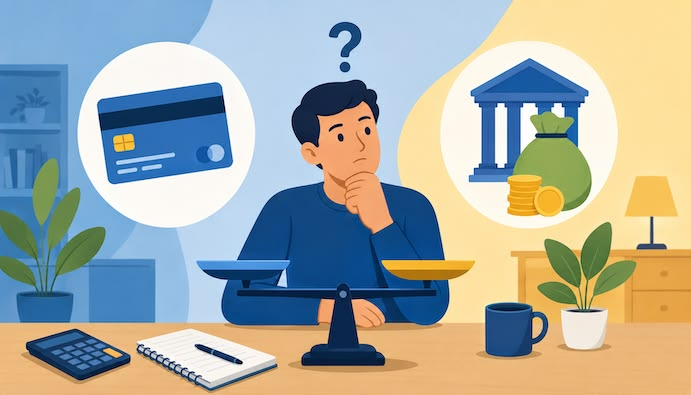
Personal loans aren’t automatically good or bad.
It depends on how you use them.
A personal loan can make sense for situations such as:
- Consolidating expensive debt
- Paying for a necessary home repair
- Covering a major planned expense
- Financing an expense with a clear repayment plan
- Replacing higher-cost debt with a lower-cost option
Debt consolidation is one example where the numbers can potentially work in your favor.
Suppose you have several high-interest balances and qualify for a personal loan with a lower APR.
Combining those balances into one fixed payment could make your debt easier to manage.
But there is a catch.
A lower monthly payment does not automatically mean you are saving money.
A longer repayment period can reduce the monthly bill while increasing the total amount of interest you pay.
Shorter Term vs. Longer Term: Which Is Better?
Consider this simple example.
You borrow $15,000.
A shorter repayment term may produce a larger monthly payment but reduce the amount of time interest accumulates.
A longer term may feel easier every month, but you could pay interest for several additional years.
| Repayment term | Monthly payment | Total interest | Budget pressure |
|---|---|---|---|
| Shorter | Higher | Usually lower | Higher |
| Longer | Lower | Usually higher | Lower |
The exact numbers depend on the APR and loan structure.
So when comparing offers, ask yourself two questions:
Can I comfortably afford the monthly payment?
and
Am I comfortable with the total amount I will repay?
You need a “yes” to both.
Don’t Borrow Based Only on the Monthly Payment
This deserves its own section because it is one of the easiest traps to fall into.
Imagine a lender says:
That sounds comfortable.
But what if the loan lasts six years?
Now the important question becomes:
How much will I pay altogether?
A lower monthly payment can sometimes hide a longer repayment period.
Before accepting a loan, write down:
Loan amount + interest + fees = total repayment cost
Then compare that figure with your budget and your alternatives.
How Much Should You Borrow?
The answer isn’t:
“As much as the lender approves.”
A lender’s maximum approval amount is not necessarily the amount you should borrow.
Instead, start with the expense itself.
If your necessary repair costs $7,000, borrowing $12,000 simply because you’re approved for $12,000 may create unnecessary debt.
A practical approach is:
Step 1: Identify the exact expense
Know why you’re borrowing.
Step 2: Check your available cash
Could you cover part of the expense without emptying your emergency savings?
Step 3: Borrow only the remaining amount
Avoid adding unnecessary spending to the loan.
Step 4: Calculate the total repayment
Don’t stop at the monthly payment.
Step 5: Check whether the payment fits your budget
Leave room for rent or mortgage, utilities, food, transportation, savings and unexpected expenses.
Your Credit Score Can Change the Cost of Borrowing
Credit scores aren’t the only factor lenders consider, but they can have a significant impact on loan pricing.
Generally, stronger credit profiles can qualify for more competitive rates.
Current October 2026 data illustrates the difference. NerdWallet’s recent anonymized offer data showed average personal-loan APRs of about 15.13% for excellent-credit borrowers, 19.54% for good-credit borrowers, 23.68% for fair-credit borrowers and 27.27% for bad-credit borrowers.
These aren’t guaranteed rates. They are simply a snapshot of current offers.
That’s why checking your credit before borrowing can be worthwhile.
If your credit report contains an error, correcting it before applying may help you avoid being evaluated on inaccurate information.
Shop Around Before You Apply
There is no prize for accepting the first loan offer.
Different lenders may evaluate the same borrower differently.
Before submitting a formal application, compare:
| What to compare | Why it matters |
|---|---|
| APR | Helps compare borrowing cost |
| Interest rate | Determines interest charged |
| Loan term | Affects payment and total interest |
| Origination fee | Adds to borrowing cost |
| Late fee | Matters if payment is missed |
| Prepayment rules | Important if you repay early |
| Funding time | Matters for urgent expenses |
| Minimum credit requirements | Helps you target suitable lenders |
| Monthly payment | Must fit your budget |
| Total repayment | Shows the bigger picture |
Whenever possible, look for lenders that allow pre-qualification without immediately triggering a hard credit inquiry.
That gives you an opportunity to compare potential offers before committing.
Loan Fees Can Quietly Increase the Cost
Interest isn’t always the only cost.
Depending on the lender and loan, you may encounter fees such as:
- Origination fees
- Application fees
- Late-payment fees
- Returned-payment fees
- Prepayment penalties
- Annual fees in certain products
Not every loan has all of these.
That’s exactly why reading the agreement matters.
A loan that appears cheaper at first glance can become more expensive after fees are included.
What About Borrowing With Bad Credit?

Having poor credit doesn’t necessarily mean you cannot borrow.
But it can make borrowing more expensive.
Lenders may see a weaker credit profile as a higher risk and price the loan accordingly.
The temptation in this situation is understandable:
“Someone approved me, so I should take it.”
But that’s exactly when you need to slow down.
If the APR is extremely high, ask whether the loan solves the problem or simply moves the problem into the future.
Before accepting a high-cost loan, consider whether you can:
- Wait and save more money
- Reduce the expense
- Negotiate the bill
- Ask about a payment plan
- Compare a credit union
- Use a secured option where appropriate
- Borrow a smaller amount
- Improve your credit before applying
The best loan isn’t necessarily the one you can qualify for today.
Sometimes the smartest borrowing decision is waiting until you can qualify for a better deal.
Debt Consolidation: Helpful Tool or Debt Reset Button?
Debt consolidation can be useful, but it isn’t magic.
Imagine you have four credit card balances.
You replace them with one personal loan.
You now have:
One payment. One due date. One interest rate.
That can make your financial life easier.
But the consolidation only really helps if the overall numbers improve.
Ask:
- Is the new APR lower?
- Are the fees reasonable?
- Is the repayment period manageable?
- Will the new payment fit my budget?
- Can I avoid building the credit-card balances back up?
That last question is often overlooked.
If you consolidate $10,000 of credit-card debt and then immediately start spending on those cards again, you may end up with both the consolidation loan and new credit-card debt.
That’s not consolidation.
That’s multiplication.
Borrowing for an Emergency Requires Extra Care
Unexpected expenses happen.
A broken car, urgent home repair or major medical-related bill can arrive at the worst possible time.
When you’re under pressure, it is easy to focus on speed rather than cost.
Try to separate the two questions:
How quickly do I need the money?
and
What is the least expensive responsible way to get it?
If you have an emergency fund, this is one of the situations it is designed for.
If you don’t have enough savings, compare every realistic option rather than automatically choosing the fastest loan.
Be Careful With “Guaranteed Approval” Loan Offers
This is one of the most important safety rules in modern borrowing.
Be cautious when an offer promises:
- Guaranteed approval
- No credit check
- Extremely low rates for everyone
- Immediate cash with no questions
- Pressure to pay an upfront fee
- Requests for unusual payment methods
- Requests for sensitive information before you verify the lender
Legitimate lenders still have requirements.
And a legitimate lender should be willing to explain the loan terms clearly.
If someone is rushing you into a financial decision, take a step back.
A genuine financial opportunity should survive a few minutes of careful research.
A Quick Loan Comparison Formula
Before accepting any loan, use this simple framework:
1. What am I borrowing?
Write down the exact amount.
2. Why am I borrowing?
If you can’t clearly explain the purpose, stop and reconsider.
3. What is the APR?
Don’t look only at the advertised interest rate.
4. What are the fees?
Check the agreement.
5. How much is the monthly payment?
Make sure it fits comfortably into your budget.
6. How long will I repay?
A longer term isn’t automatically better.
7. What is the total repayment?
This is the number that tells you what the loan really costs.
The 2026 Borrowing Checklist
Before signing a loan agreement, run through this checklist:
| Question | Yes/No |
|---|---|
| Do I actually need to borrow this money? | ☐ |
| Do I know exactly how much I need? | ☐ |
| Have I compared multiple lenders? | ☐ |
| Have I checked the APR? | ☐ |
| Have I reviewed the fees? | ☐ |
| Do I understand the repayment term? | ☐ |
| Can I comfortably afford the monthly payment? | ☐ |
| Do I know the total repayment amount? | ☐ |
| Have I checked whether there are early-payment penalties? | ☐ |
| Is the lender legitimate and properly verified? | ☐ |
| Do I understand what happens if I miss a payment? | ☐ |
If you cannot confidently answer several of these questions, you’re probably not ready to sign.
What Current 2026 Data Is Telling Borrowers

The lending market is changing, but one message remains consistent: credit is available, but the cost of credit matters.
In the U.S., unsecured personal-loan rates remain meaningful. The Bankrate/FRED index stood at 12.53% at the end of September, while other current marketplace data shows that individual offers can vary substantially depending on credit quality and loan terms.
BNPL is another example. Its growing use hasn’t eliminated repayment risk; LendingTree’s latest research found that 47% of users surveyed had paid late during the previous year.
Meanwhile, borrowing trends in other major markets are also changing. In India, for example, RBI-linked August 2026 data showed personal-loan growth of 16.9% year over year, while gold-backed borrowing grew particularly quickly.
The broader lesson is not that one type of loan is always better.
It’s that borrowers are becoming more selective about cost, security, convenience and repayment risk.
Smart Borrowing in 2026 Is About More Than Getting Approved
There was a time when getting approved for a loan felt like the finish line.
It isn’t.
Approval is just the beginning.
The real questions come afterward:
Can I afford this?
Is this the right type of loan?
Did I compare enough options?
What will I pay in total?
What happens if my financial situation changes?
Those questions aren’t exciting.
They don’t make for flashy loan advertisements.
But they are the questions that can save you hundreds or thousands of dollars over the life of a loan.
A Better Way to Think About Borrowing
Think of borrowing as buying money for a period of time.
The longer you use it, and the more expensive the rate and fees are, the more you pay for that money.
That doesn’t make borrowing bad.
A well-chosen loan can help you handle an important expense, consolidate expensive debt, purchase a home, finance education, replace a vehicle or manage a carefully planned financial goal.
The problem begins when borrowing becomes a substitute for budgeting.
If you’re repeatedly borrowing to pay ordinary monthly expenses, the issue may not be the individual loan.
It may be the gap between your income and your regular spending.
That’s a bigger problem—and it deserves a bigger solution.
Final Thoughts: Borrow Smart, Not Just Fast
Loans can be useful financial tools.
But a loan should make your financial situation more manageable, not simply make today’s problem disappear until next month.
In 2026, borrowers have more choices than ever. Online lenders, banks, credit unions, digital platforms, BNPL services and traditional secured loans all compete for customers.
That competition can work in your favor—but only if you compare.
Before borrowing, know your numbers.
Know the APR.
Know the fees.
Know the monthly payment.
Know the total repayment.
And most importantly, know why you’re borrowing in the first place.
The smartest borrower isn’t necessarily the person who gets the biggest loan or the fastest approval.
It’s the person who understands the cost before saying yes.
FAQ’s